
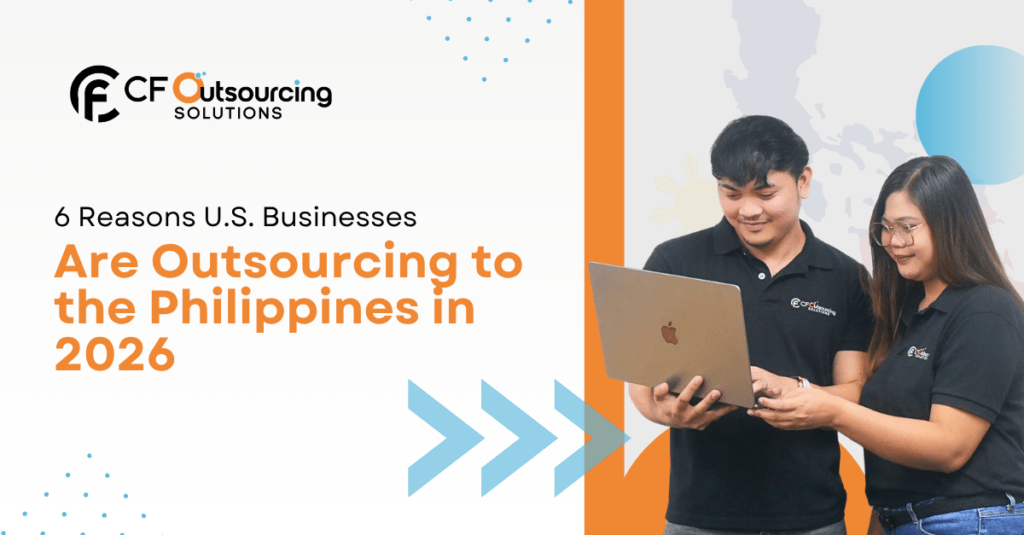
Let’s be honest. Running a business in 2026 is expensive. Hiring is a headache. The idea of building a team that’s skilled, reliable, and won’t blow your budget? The pressure is immense that you just can’t contain it any more. CF Outsourcing Solutions was built for exactly this moment.
But here’s what a growing number of U.S. businesses have quietly figured out: the answer isn’t working harder to find local talent. It’s working smarter — and looking at the Philippines.
This isn’t a new trend. But the reasons businesses are choosing the Philippines right now are more compelling than ever. Let’s break it down.
1. The Cost Savings Are Hard to Ignore
Let’s start with the number that gets everyone’s attention.
When you build a team in the Philippines, you’re not cutting corners — you’re cutting waste. The cost of living difference between the U.S. and the Philippines means that a skilled, experienced professional there earns a fraction of what the same role would cost you stateside. We’re talking savings of up to 70% on labor alone.
That’s not money you pocket and forget about. That’s a budget you can redirect into growth — better tools, more marketing, product development, or simply breathing room.
And before anyone raises an eyebrow: this isn’t about paying people less than they deserve. It’s about operating in a different economy, where those salaries represent strong, competitive compensation. It’s smart budgeting. Full stop.
2. They Speak Your Language — Literally
The Philippines has one of the highest English proficiency rates in all of Asia. It’s been an official language there for decades, taught in schools from day one, and woven into daily life in a way that’s hard to match anywhere else in the region.
But it’s more than just language. It’s cultural fluency.
Filipinos grew up watching American TV, following U.S. sports, celebrating holidays they first encountered through global media, and navigating a business culture that mirrors yours in more ways than you’d expect. That means less time spent on cultural onboarding, fewer miscommunications, and teams that get your customers because they genuinely understand them.
The Filipino Work Ethic: The “Malasakit” Advantage — EQ You Can’t Train
Here’s something no outsourcing brochure talks about enough: emotional intelligence.
There’s a Filipino concept called malasakit — a deep, genuine sense of care and concern for others. It’s not a corporate value posted on a wall. It’s a cultural instinct that shows up in how people work, communicate, and treat the humans on the other end of every interaction.
You can script a customer service conversation. You can train someone on your product. But you cannot manufacture warmth, patience, or the instinct to actually solve someone’s problem rather than just close the ticket. That emotional intelligence is what separates a good customer experience from a great one — and it’s baked into the Filipino workforce at a cultural level.
3. The Philippines Has a Large and Skilled Talent Pool
The Philippines produces hundreds of thousands of college graduates every year across fields like business, healthcare, IT, finance, and communications. And unlike some markets where the talent pipeline is aging or shrinking, the Filipino workforce skews young — median age of 25 — and that matters more than most people realize.
Built for the Digital Age — The Under-35 Workforce
This generation didn’t just grow up with technology — they grew up inside it. Slack, Notion, Asana, AI tools, cloud platforms — these aren’t things they had to learn in a seminar. They navigated all of it before they ever had a job title. Onboarding them into your tech stack isn’t a project. It’s practically a formality.
If your previous hiring experiences have been defined by slow ramp-up times, tool confusion, and teams that needed months to reach full productivity — this is the workforce that changes that dynamic. Filipino professionals under 35 show up already fluent in the tools, the workflows, and the pace that modern U.S. businesses demand. For companies trying to build or scale a high-performance team, that kind of readiness isn’t a convenience. It’s a genuine competitive advantage.
4. Outsourcing Is Not as Complicated as You Think
We hear this all the time from business owners considering outsourcing for the first time: “But managing a team overseas sounds like a whole thing.”
It’s really not — especially when you have the right partner.
Time zones? Filipino teams are used to working U.S. business hours. Communication? The tools are the same ones your in-house team already uses. Cultural alignment? See section two. And with the right infrastructure and support in place, your offshore team won’t feel like an extension. It’ll feel like your team — because that’s exactly what they are.
CF Outsourcing is built around making this transition seamless. From recruitment to daily operations, we handle the setup so you can stay focused on the work that actually grows your business.
5. What U.S. Businesses Are Actually Outsourcing
Businesses outsource a wide range of roles to the Philippines. A few of the most in-demand:
- Customer Service & Support — Voice, chat, email. The bread and butter of Philippine outsourcing, and still one of the strongest.
- Revenue Cycle Management — Medical billing, coding, claims, and denial management. A specialty of CF Outsourcing.
- Virtual Assistance & Back-Office — Scheduling, admin, data management. High-volume work that doesn’t need to eat up your local team’s time.
- IT Support & Help Desk — System monitoring, troubleshooting, and technical support around the clock.
- Digital Marketing — Content, SEO, social media, paid campaigns.
- Credentialing & Contracting — A highly specialized function where accuracy is everything.
The truth is, if you have a BPO task that needs doing, there’s a good chance a Filipino professional has already mastered it — and probably has ideas on how to do it better. Explore our full list of solutions and see what’s possible.
6. 🚨 This One’s Urgent: The U.S. Talent Shortage Isn’t Getting Better
For many U.S. businesses, the domestic hiring cycle has become a drain in itself — weeks of waiting, a thin applicant pool, a hire that doesn’t stick, and then starting over.
The Signal Flare Is Already Up. Are You Seeing It?
The numbers are not subtle. The U.S. shed 92,000 jobs in February 2026 — and that’s after months of stagnant hiring that economists have described as “frozen.” Job openings have been declining steadily, but so has the number of workers available and willing to fill them. Labor force participation sits at 62% — its lowest point since late 2021.
Translation: the pool of available domestic talent isn’t refilling. It’s shrinking.
The industries hit hardest? Healthcare, IT, finance, and business support — the exact roles that Philippine outsourcing was built for. Even if you find candidates locally, you’re competing with every other business in your market for the same limited people, paying more, and often still coming up short.
Outsourcing to the Philippines used to be a smart move to save money. In 2026, for many businesses, it’s becoming a necessary move to survive the gap. The signal flare has been in the air for a while now. The question is whether you’re ready to respond.
The Philippines Is Ready. Are You?
CF Outsourcing exists because we believe building a great team shouldn’t cost you everything — and it shouldn’t keep you up at night. We’ve helped U.S. businesses find exceptional Filipino talent across dozens of roles, and we’re proud of every single placement.
The workforce is here. The talent is real. And the businesses winning right now are the ones who stopped waiting.